
 |
Manufactured by Eli Whitney, Newhaven, late 1864/early 1865 in the
"Navy" .36 calibre. Unusually, this is London Proofed and not Martially
marked. It is a 2nd Model 6th Type with large trigger guard. This model
bears design similarities to the Remington M1858 and the Colt models
(probably designed after the Colt and Remington patents had expired).
Also copied by the Confederate gun makers Spiller & Burr. This
particular example features in Dan Williams' book, "The Whitney Navy
Revolver: A Reference of the Models and Types, 1857-1866". More information on the book. |
|
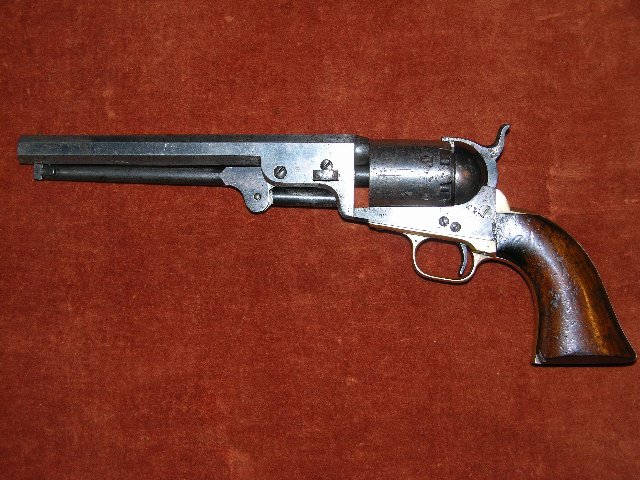 |
Originally known as Colt's Navy revolving belt pistol, this .36
calibre "Navy" revolver later became known as the model 1851
Navy. This example dates from 1853 and is quite an early pre-Civil War
private purchase revolver with no martial markings. Traces of silver
plating to trigger guard and backstrap. Case hardening to frame and no
trace of blueing to the barrel or cylinder. No trace of Cylinder scene, but
barrel top strap has the early NewYork address. This is a Third Model,
bead sight, loading lever screw on right side and small trigger guard. More information on this model. |
|
 |
Remington
New Model Army, based on the 1858 design (the "old" model army - Beal's
patent). In .44 calibre - also available in .36 (scarcer). This
Martially marked example was originally issued to the 8th Michigan
Volunteer Cavalry in 1865. 8inch hexagonal barrel. More information on this model. |
|
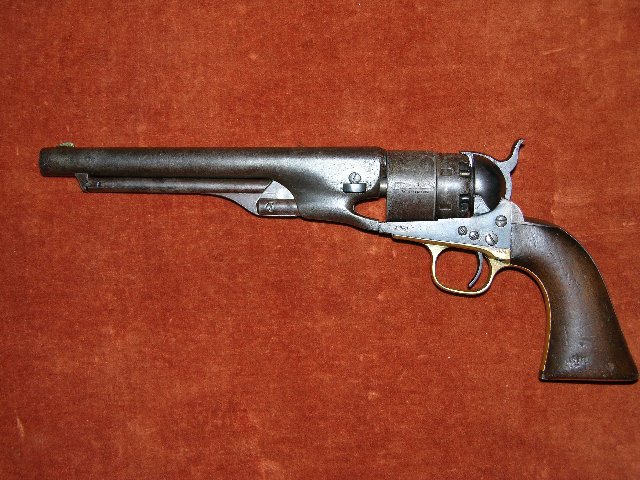 |
Colt Model 1860 Army in .44 calibre, barrel address of New York,
U.S. America. Martially marked and serial number dates it to 1862. More information on this model. |
|
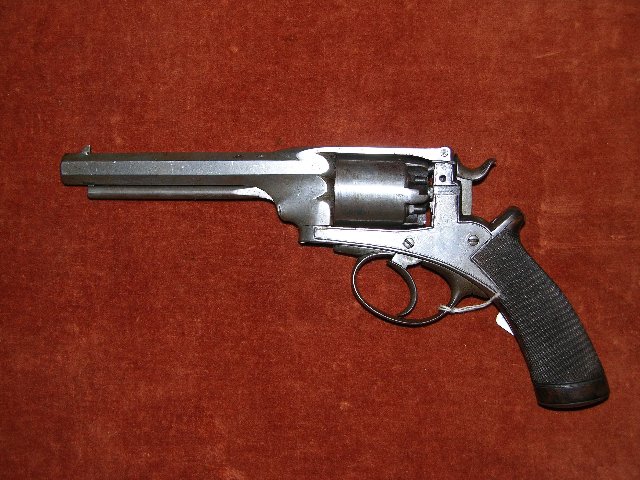 |
A Deane-Harding 5 shot, 54 Bore revolver using Harding's patent and manufatured by Deane & Son, London Bridge. This revolver, like most British designs, is trigger cocking, but can also be thumb cocked. London Proof and View marks. Woodwork by Thomas Tipping & Lawden (later taken over by Webley). Made about 1859. Never adopted by the British Military as there was a design flaw by having a single spring system to operate the cylinder stop and pawl. When this broke, which was often, the revolver became completely useless. | |
 |
A William Tranter, 4th Model, patent 5 shot, 54 Bore, single trigger revolver.
It is trigger cocking but can be used thumb cocked (so called "double-
action"). Retailed by John Hayton of Graham's Town, Eastern Cape c.1862. To see a quality animation of this type of revolver, in action, then click here More information on William Tranter. |


